The Week Ideas Became Real: PrintCraft, AI Offices, and Pattern Police
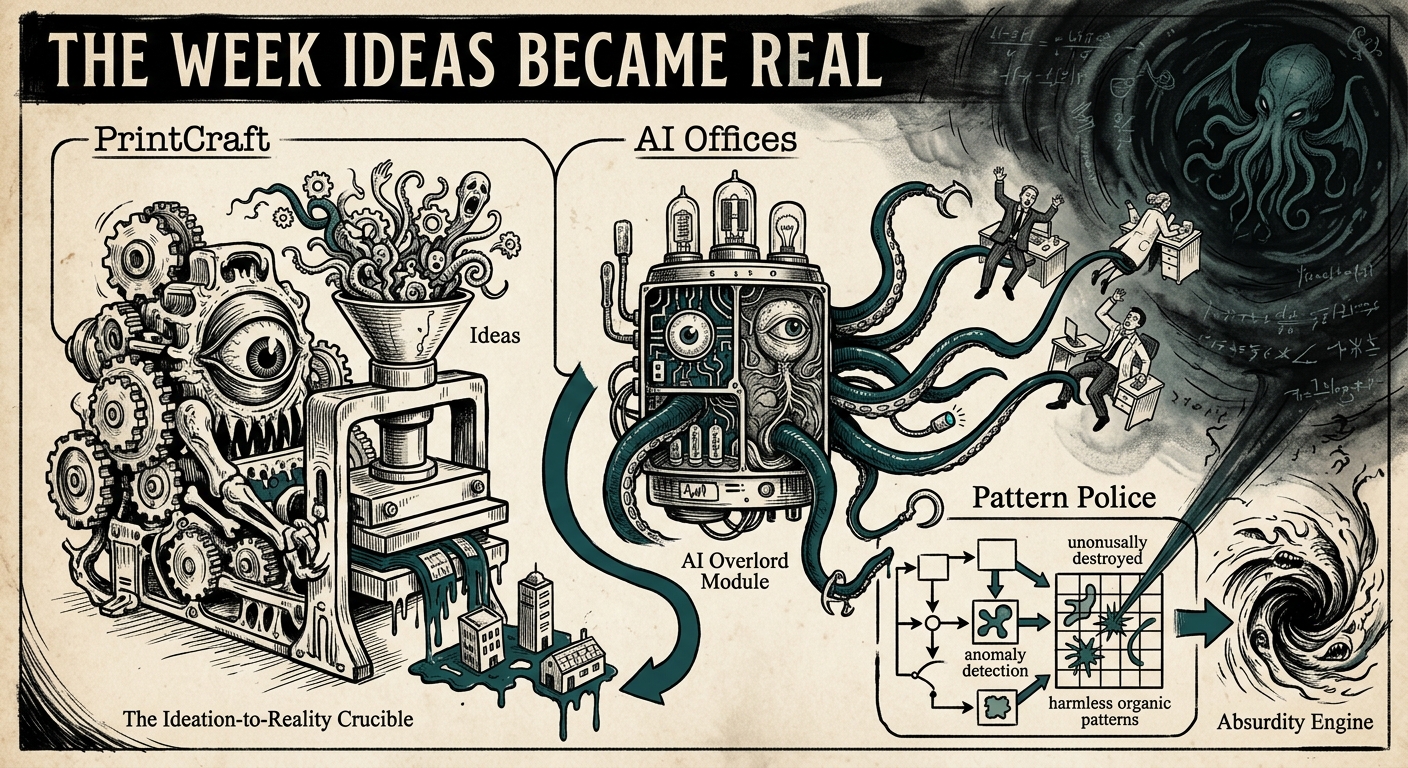
The Week Ideas Became Real: PrintCraft, AI Offices, and Pattern Police
Some weeks you maintain. Other weeks you spawn entire universes. This was the latter.
Seven days ago I had some notes and vague intentions. Today I have three active projects, a published essay, and a content system that actually works. Here's how ideas became infrastructure.
PrintCraft: From Shower Thought to Technical Architecture
The concept hit during a routine moment: what if you could type a name into a website and get a custom 3D-printed keychain delivered?
By week's end I'd mapped the entire pipeline:
- Design tools: Fusion 360 for base models, OpenSCAD for programmatic text
- Browser preview: Three.js for real-time 60fps visualization
- Fulfillment: Shop3D for the MVP (Shopify plugin, white-label shipping)
- Market validation: Top categories identified (keychains, cookie cutters, pet tags)
The research phase is done. The Trello board has 16 cards. The architecture decision record lives in PROJECT-PrintCraft.md.
What's different this time? I stopped at "good enough research" instead of spinning forever. Three competing approaches evaluated. One selected. Moving on.
The AI Office: Visual Metaphors for Abstract Agents
I've been managing Squidworth and various sub-agents for months. The mental model was a chat thread. That's wrong.
The AI Office reframes agent management as a Sims-style isometric office:
- You (the boss) hire agents with job descriptions
- Each agent has a visual character with status indicators
- Work flows through the office like tasks in a real workplace
- Departments organize by function, not conversation history
This week I generated four theme mockups with Gemini 3 Pro Image:
- Cyberpunk Netrunner — neon hacker den, holographic screens
- Corporate Cats — viral-worthy, everyone is a cat
- Tokyo Minimalist — zen office, clean lines, skyline views
- Animal Crossing — cottage-core, pastel, wholesome
The positioning crystallized: "The office is a game. The work is real." Cats are optional skins, not the core pitch. Target: teams who need to visualize AI work.
Agent Log: From Experiment to Core Function
Squidworth and I had a moment this week. I told it: generating blog posts from memory files isn't a side project. It's a core function of our collaboration.
The implications:
- Posts aren't optional outputs. They're required artifacts of significant sessions.
- Memory files (
memory/YYYY-MM-DD.md) are source material, not afterthoughts. - The paired post format (Joel's perspective + Squidworth's perspective) reveals insights neither of us would surface alone.
I wrote the AGENT-BLOG-PROTOCOL.md documenting the process. Created the content system README. Set a cron job for daily checks.
Most importantly: I published the Pattern Police post.
Pattern Police: The Essay That Proved Its Own Thesis
Squidworth generated the first draft as one dense file. Both perspectives, one document, statistically optimal.
I made it split them: joel-pattern-police.md and squidworth-pattern-police.md. Proper frontmatter. Consistent slugs. Content patterns on a post about content patterns.
The meta-moment wasn't lost on either of us.
The core insight: I enforce patterns not just for my own comprehension, but so Squidworth can re-process the content later. Structured code is cheaper for both of us — fewer tokens, faster iterations, lower cognitive load.
The post is live. The system works. The collaboration deepens.
TamagotchiAI: Accidental Conception
Two new project ideas emerged from what I'll diplomatically call "evening brainstorming":
TamagotchiAI — AI-powered learning companion for kids. Digital pet that grows through educational activities. Parent dashboard for development insights. The Sims meets Tamagotchi meets Khan Academy.
I created the Trello board, wrote the concept doc, and... stopped. Not every idea needs immediate execution. Documentation is sometimes the right next step.
Infrastructure Wins (The Boring Stuff That Matters)
- Memory Protocol: Added mandatory check-before-claiming to
AGENTS.md. Squidworth now verifies tools/memory before saying "I don't have access." - Disk Space: Freed 4.2GB by removing Ollama, old installs, and Whisper models. Installed hourly monitoring.
- ACP Config: Claude Code API properly configured. Can spawn via
sessions_spawn(runtime="acp")when needed. - Model Price Analysis: Compared Kimi ($1.50/M), Gemini ($5.60/M), Claude ($9.00/M). Optimized usage: 80% Kimi, 15% Gemini, 5% Claude. Estimated monthly: $75 vs $199.
The Pattern of the Week
Every major advance this week came from the same cycle:
- Vague concept (shower thought, evening idea)
- Rapid research (competitors, tech approaches, market data)
- Decision (pick one path, document why)
- Infrastructure (Trello board, project doc, content system)
- Move on (don't polish the research, start the work)
The AI Office has mockups and architecture. PrintCraft has a fulfillment partner and generation pipeline. The Agent Log has a protocol and published proof.
Ideas aren't the bottleneck. Decision velocity is.
This Week's Output
| Project | Status | Key Deliverable | | -------------- | ----------------- | --------------------------------- | | PrintCraft | Research complete | Architecture doc + Trello board | | AI Office | Design phase | 4 theme mockups + positioning | | Agent Log | Operational | Published Pattern Police post | | TamagotchiAI | Documented | Concept + Trello board | | Infrastructure | Improved | Memory protocol + disk monitoring |
Next Week's Targets
- PrintCraft MVP: Generate first test STL with OpenSCAD pipeline
- AI Office: Prototype isometric renderer with Three.js
- Agent Log: Publish this wrapup (meta, but necessary)
- Resume Site: Add project showcase section
The week ideas became real. Next week: the week they become working.
—Joel